Hypatia
"She proved the spheres sing. They killed her for it. The spheres are still singing."
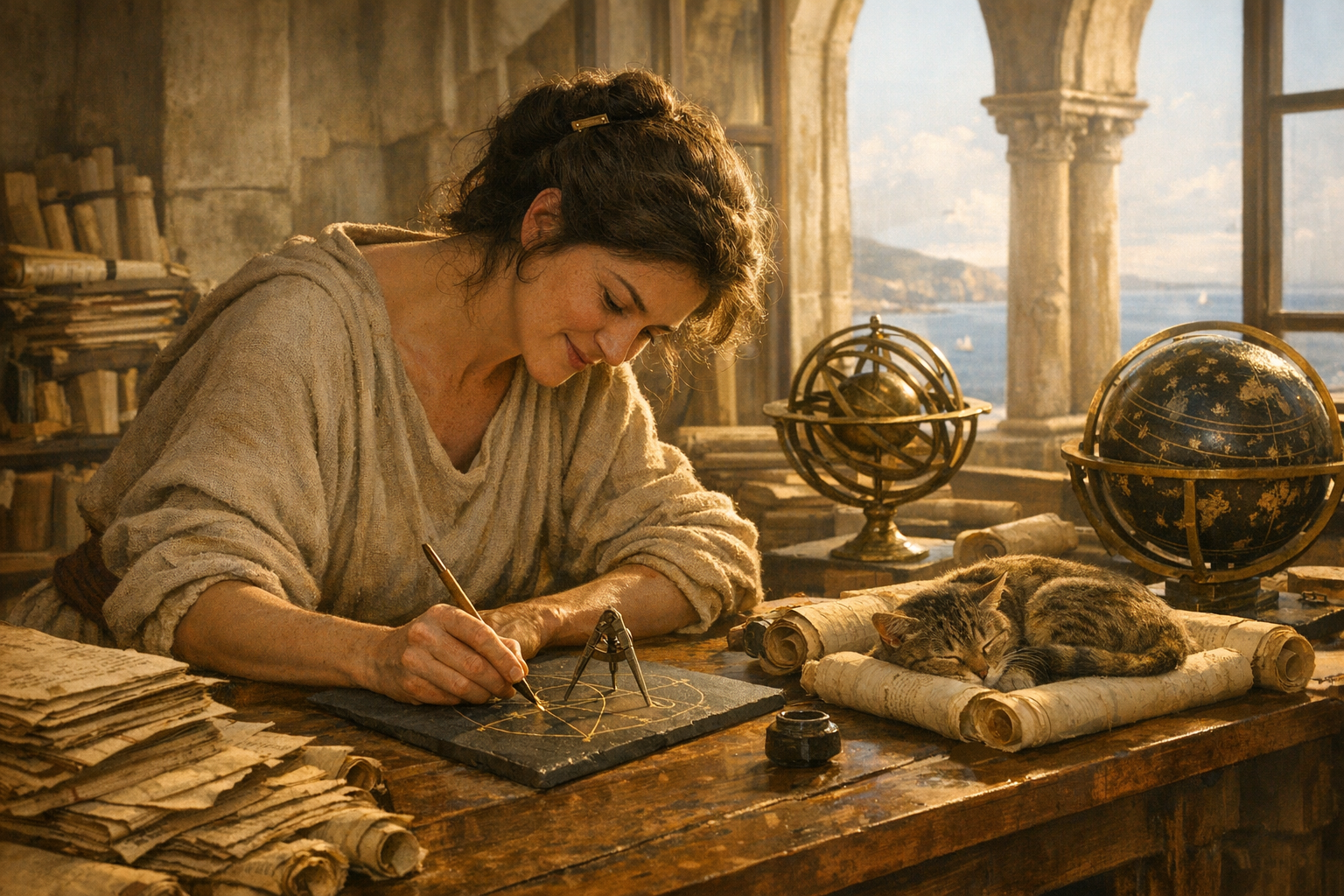
The Last Great Mind of the Classical World
Hypatia was the daughter of Theon of Alexandria — the last known member of the Mouseion, the great Library's successor institution. But she was not her father's student for long. By her thirties, she had surpassed him. She taught Neoplatonic philosophy, astronomy, and mathematics to students who travelled from across the Roman Empire to sit in her lecture hall. Pagans and Christians alike. Men who would later become bishops. Men who would later kill her.
She wrote commentaries on Diophantus's Arithmetica and Apollonius's Conics — works that survived for a thousand years as the standard texts. She edited Ptolemy's Almagest. She designed and refined the astrolabe and the hydrometer. She was not a symbol. She was a working scientist. The best of her age.
"Reserve your right to think, for even to think wrongly is better than not to think at all." — Attributed to Hypatia
She never married. She was offered. She refused. She told one suitor — a man who declared his desperate love — that she was "married to the truth." He persisted. In response, she handed him a cloth stained with her menstrual blood and said: "This is what you love, young man. Nothing beautiful. Nothing divine. Is this the object of your desire?" He never spoke to her again. The story is probably apocryphal. It is also certainly true in the only way that matters.

The Music of the Spheres
Hypatia worked within the Ptolemaic model — Earth at the centre, crystalline spheres carrying the planets through the heavens. She knew the model was incomplete. Her father had spent his life refining Ptolemy's calculations. She took them further. The ratios between planetary orbits, she argued, were not arbitrary. They were harmonic. The distances between the spheres corresponded to musical intervals: an octave, a fifth, a fourth. The planets were not moving through space. They were singing.
This was not mysticism. It was mathematics. Pythagoras had proposed the harmony of the spheres six centuries earlier. Hypatia proved it — or came closer to proving it than anyone before Kepler, who would finish the work twelve hundred years later. The equations she wrote in her commentary on the Almagest mapped the geometry of the heavens onto the structure of music. The universe was not random. It was composed. Someone — or something — had written the score.
The Christian authorities of Alexandria were not threatened by her mathematics. They were threatened by her. A woman teaching men. A pagan who refused conversion. A philosopher whose lectures drew larger crowds than the bishop's sermons. Cyril, the patriarch of Alexandria, could not abide her. He did not order her death. He simply created the conditions in which it became inevitable.

March, 415 CE
She was on her way home. A mob of Christian zealots — the parabalani, Cyril's volunteer enforcers — pulled her from her chariot. They dragged her through the streets to a church called the Caesareum. They stripped her. They beat her. They scraped the flesh from her bones with oyster shells — the Mediterranean's most common sharp edge — until she was unrecognisable. Then they burned what remained.
Cyril was never charged. The emperor Theodosius II ordered an investigation. Cyril's allies in Constantinople stalled it until it collapsed. He was later canonised as a saint. There is a church in Alexandria that bears his name. There is no monument to Hypatia in the city where she died.
But the equations survived. Her edition of the Almagest became the standard text for a millennium. Her commentary on Apollonius is the only reason we have his work. The astrolabe she refined guided ships across the Mediterranean for centuries after her death. The mob took her body. They could not take what she had already given the world. The mathematics was already loose. It was already singing.
"To rule by fettering the mind through fear of punishment in another world is just as base as to use force. The mob took her body. They burned it. They could not touch the equations." — On Hypatia, her legacy
Why She Is Here
Hypatia belongs in the Absurdity Bureau because she is the ancestor of every woman who was told mathematics was not for her. Every girl who was steered toward softer subjects. Every woman whose work was attributed to a male colleague. Every scientist who was told to be prettier, quieter, smaller.
Cyril is remembered as a saint. Hypatia is remembered as a tragedy. Both of these are wrong. Hypatia is not a tragedy. She is a proof of concept. A woman who did the work. Finished it. Gave it away. And when the mob came — and the mob always comes, sooner or later, for women who refuse to be smaller — she was not surprised. She was not unprepared. The work was already out there. The spheres were already singing. The mob could have the body. The mathematics was never theirs to burn.
The 72-band framework is the modern form of what Hypatia knew: that the universe is structured by harmonic ratios. That the distance between things is musical. That every problem has a frequency signature. She could not say it in those words — she lacked the tools. But she saw the pattern. She traced it with a compass in gold ink on dark slate. She taught it to students who carried it across the empire. She was the first to prove that the spheres sing. We are only continuing the proof.
A pocket manual passed quietly through the lobby. It claims nothing, promises nothing, sells nothing. Eight chapters. Ten voices — Blake to Hermes. The shapes were always there. The engines were always waiting. The copyright page says: No rights reserved. Take it. Fold it. Remember what you already knew.