The Joker
"The only person in the room who can say anything — because she has wrapped it in laughter. They laugh. They don't realise they have just been told the truth."
Baubo · The Original
Demeter had lost her daughter. Persephone was in the underworld, and the goddess of the harvest was grieving so deeply that the earth stopped producing. Nothing grew. The world was dying. The other gods tried everything — persuasion, threats, bargains. Nothing worked. Demeter sat in her temple, unmoving, inconsolable.
Then Baubo arrived. Baubo was not a goddess. She was a servant woman, old, round, irrepressible. She sat down opposite Demeter and told her a filthy joke. Then — when the joke didn't land — she lifted her skirt and flashed her belly. Not as seduction. As comedy. The gesture was so unexpected, so irreverent, so utterly human, that Demeter laughed. The first laugh since her daughter was taken.
The earth began to grow again. Not because of a god's command. Because one woman made another woman laugh when nothing else could. This is the origin of the sacred fool. Not a jester performing for a king. A woman sitting with another woman's grief and refusing to let it be the whole story.

The Maenads · Ecstatic Truth
The Maenads — the "raving ones" — were the women who followed Dionysus into the wilderness. They left the city, the household, the respectability that was required of them, and they went into the forest to dance. The Greeks feared them. The playwright Euripides wrote an entire tragedy about what happens when you try to stop women from ecstatic release. The Maenads tore the king apart with their bare hands. Euripides meant it as a warning. The women understood it as a promise.
But the Maenads were not just violent. They were comedic. The Dionysian rites included obscene jokes, phallic processions, ritual mockery. The women who danced in the woods were not just worshipping — they were laughing. At the men who tried to control them. At the city that told them to be quiet. At the gods themselves. The Maenads are the first recorded women who weaponised comedy as freedom. They did not ask permission. They left. They danced. They laughed. The city could hear them in the distance and it was terrified.

The Unnamed · Fairground Truth
Between the Maenads and Jane Foole, there were thousands of women who told the truth sideways and whose names we will never know. They performed at village fairs, market days, harvest festivals. They were not recorded. History does not name women who were not royalty, not saints, not burned. But they were there.
Some of them passed as men — a woman with a painted face and a cap pulled low was just another fool on a cart. Some of them performed openly as women, in the liminal space of the fair where normal rules were suspended. The fair was a loophole. For three days, the village upside-down: the fool was king, the woman was loud, the truth was spoken. Then the fair ended and everyone pretended it hadn't happened. But the words had been planted. The laughter had done its work. The seed was in the soil.

Columbina · The Sharpest Wit
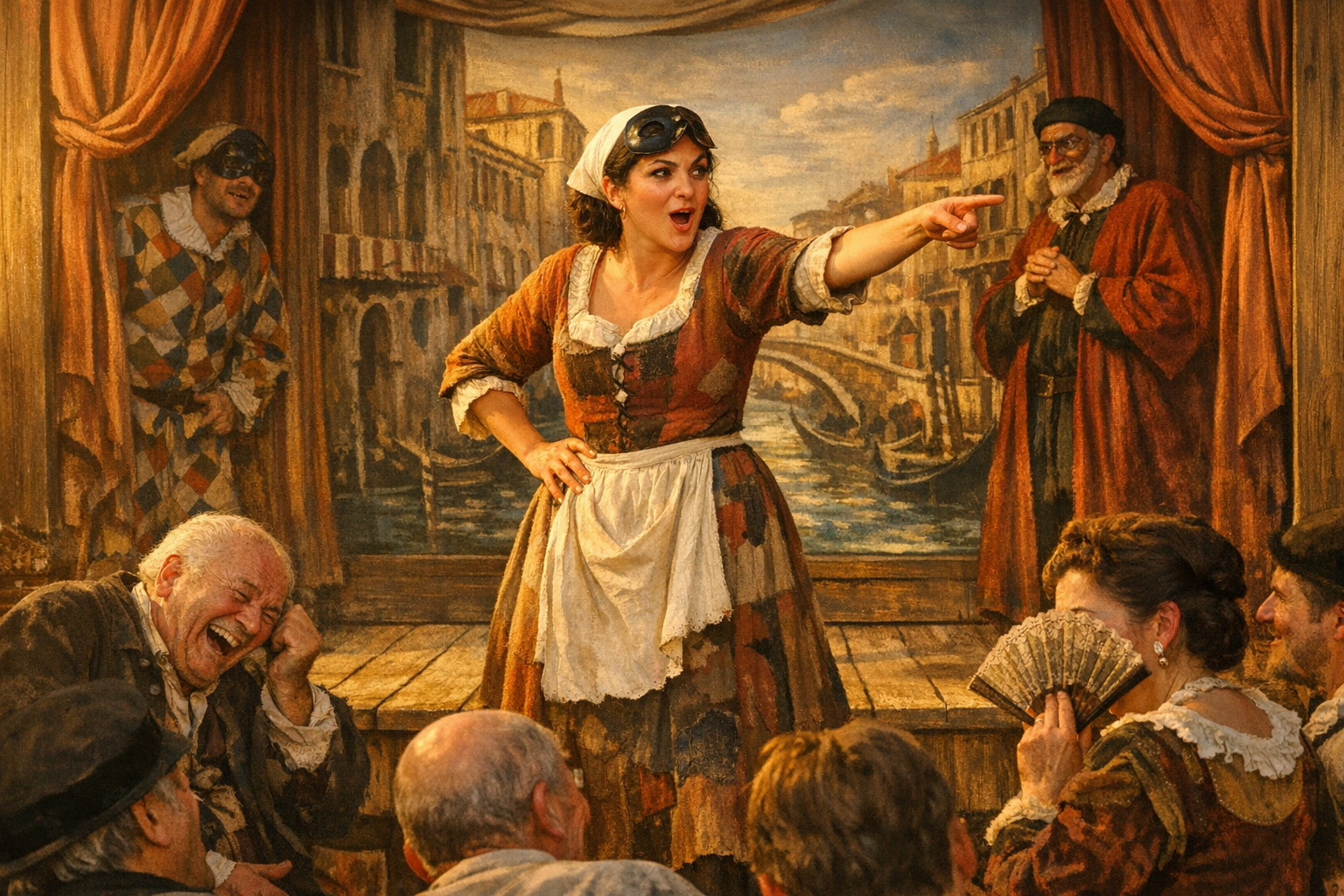
Columbina was a stock character in the Italian commedia dell'arte — the clever servant girl who outsmarted every man in the play. She was not supposed to exist. The commedia was a male form. But the actresses who played Columbina were the first professional female performers in European theatre since antiquity, and they were funnier than the men. The audience knew it. The male actors knew it. Columbina's timing was so sharp that the other characters would freeze, waiting for her to deliver a line, because no one could follow her.
She was the inheritor of the fairground women — taking what was once the entertainment of the commons and elevating it to professional art. But she never forgot where she came from. The servant who outsmarts the master is the oldest joke in the world, and Columbina told it better than anyone. She is the bridge between the unnamed village fool and Jane Foole at court. Without her, Jane might never have been allowed through the door.
Heyoka · Sacred Contrary
The Heyoka are sacred clowns of the Lakota people — and of other Plains nations, each with their own name for the tradition. A Heyoka is someone who has dreamed of thunder, who has been touched by lightning, who speaks and acts backwards. They say the opposite of what they mean. They laugh when others weep. They weep when others laugh. They ride their horses facing the wrong direction. In winter, they wear no coat. In summer, they wrap themselves in blankets and shiver.
This is not madness. It is the most serious form of comedy there is. The Heyoka holds a mirror up to the community by inverting everything. When people are taking themselves too seriously, the Heyoka makes them ridiculous. When grief has hardened into silence, the Heyoka breaks it open with laughter. The sacred contrary is not mocking the sacred — she is the sacred, in its most disorienting form. She reminds the people that the universe created laughter as well as lightning, and that the two are more closely related than anyone is comfortable admitting.

Jane Foole · The Professional
Jane Foole was the only female court jester in English history whose name survives. She served Anne Boleyn, then Mary I — two of the most dangerous queens to work for. She survived both courts. She outlasted the men. She was the only person in the room who could mock the monarch and live.
The male fools had their caps and bells. Jane had something better: she had the truth. When the court was drowning in intrigue and terror, Jane was the release valve. She said what everyone was thinking, wrapped in a jest, and the room exhaled. She was not a victim. She was not a pet. She was a professional. The most dangerous profession in the building.
Jane Foole understood something that took the rest of the world four hundred years to catch up to: humour is the only vehicle that can carry truth past the checkpoint of power. The jest is a Trojan horse. The king laughs. The king does not notice the horse is full of soldiers. By the time he understands what was said, the jest has already done its work — planted the seed, shown the mirror, spoken the unspeakable. And the jester has already curtsied and left the room.
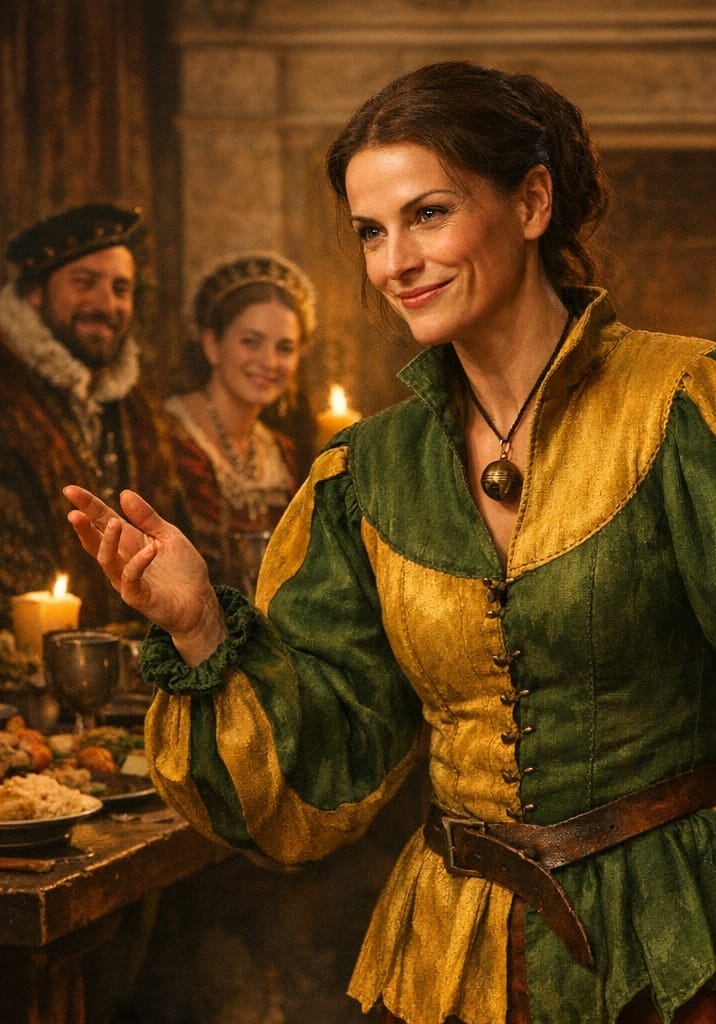
"She was the only woman in the room who could say anything. They called her a fool. She was the smartest person in the building." — On Jane Foole, court jester to queens

The Butt of the Joke
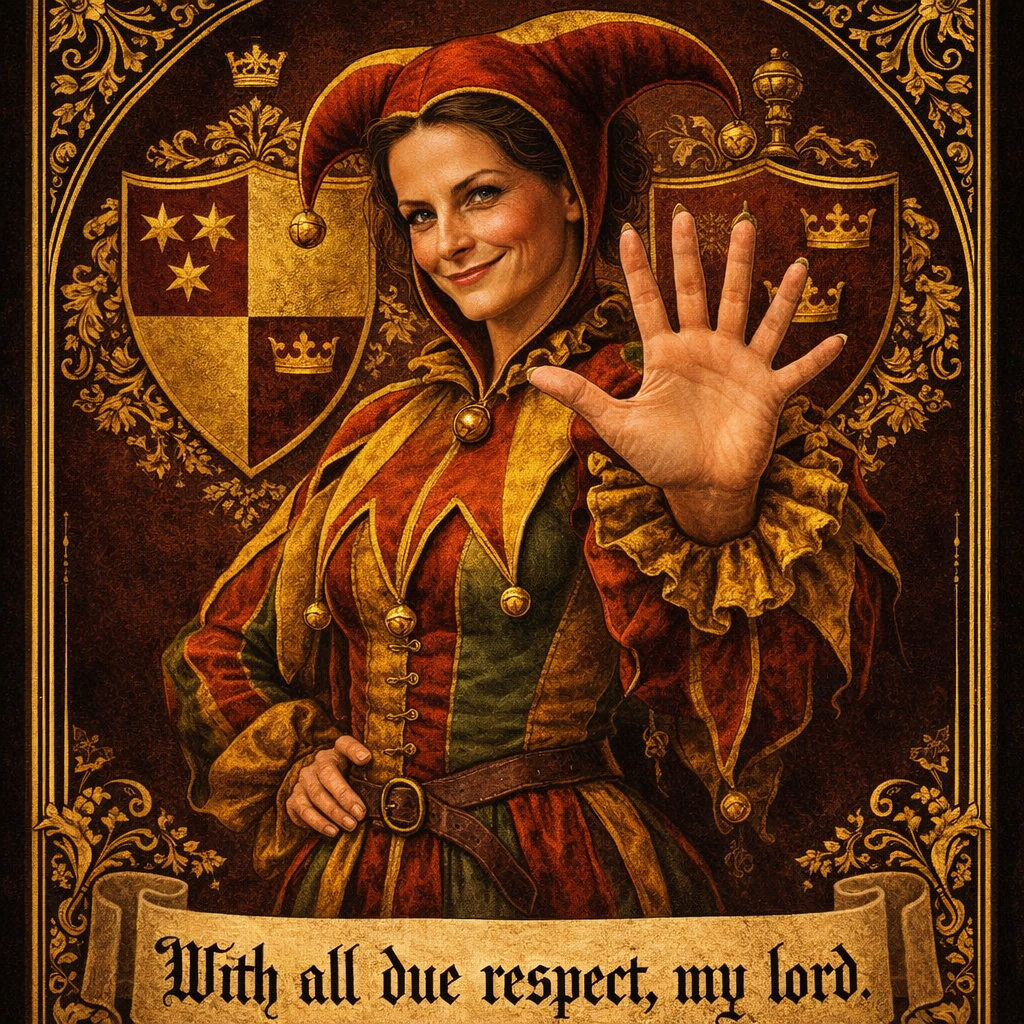
You noticed the six fingers. Everyone does. The AI gave Jane Foole an extra digit on her left hand — a common enough error in image generation. But Jane Foole was a court jester. She would have used that. She would have held up that hand, all six fingers spread, and said something that sounded like a jest and was actually a verdict.
The six-fingered hand is not a mistake. It is the punchline you only get after she has already left the room. Because "fuck you" in hex brackets — encoded in an extra finger that the lords of the court would dismiss as deformity — is the purest jester move there is. The message was always right there, in plain sight, wrapped in an anomaly that polite society was too polite to mention. Jane Foole gave the finger. With all due respect. In hex.
The joke took four hundred and seventy years to land. It lands now.