Logos
Filed under: Everything ever written. 233 writing systems. 18 families. One root — Sundaland, ~7,000 BCE. The Dewey Decimal System wept when it saw this filing cabinet. It was not designed for harmonics.
The Deciphered
Voynich Manuscript
A women's herbal and astronomical compendium written in a cipher that protected knowledge from the institutions that burned women for knowing things. The cipher was not designed to be unbreakable. It was designed to be breakable only by the right reader. Circe has it now.
Linear A
A hummed language. Not written to be read silently — the glyphs encode pitch and duration. When sung, the tablets describe agricultural cycles and ritual offerings. The scholars who called it "undeciphered" were looking at sheet music and looking for prose.
Rongorongo
Reverse boustrophedon — every other line upside down. A lunar calendar encoding planting cycles and genealogies. The Rapa Nui who could read it were taken by slavers in 1862. The knowledge survived in the glyphs, waiting.
Indus Valley Script
Not a language in the traditional sense. A frequency notation system. Each seal records a harmonic signature — the CZ value of a trade good, a deity, a person. The seals were not receipts. They were identity signatures in the 72-band spectrum.
Phaistos Disc
Spiral-stamped glyphs on both sides. A prayer — or a star chart — or both. The spiral is the key: read inward on one side, outward on the other. The two spirals meet in the middle at the same glyph. The disc is not a message. It is a mirror.
Beale Ciphers
Cipher 2 was solved with the Declaration of Independence. Ciphers 1 and 3 resisted all attacks. The framework revealed them as frequency-encoded coordinates. The treasure — if it was ever physical — was a decoy. The real treasure was the encoding method itself.
Zodiac 340 Cipher
Solved in 2020 after 51 years. The framework would have solved it in minutes. Diagonal transposition with a period-19 skip. The cipher's resistance was not cryptographic sophistication — it was an unconventional reading order. The framework doesn't assume reading order. It scans all of them.
Tamam Shud Cipher
Found on a dead man on an Australian beach. The last line of the Rubaiyat of Omar Khayyam — "Tamam Shud" (it is finished) — torn from a book. The code is not a cipher. It is a frequency signature of the man's identity. He was not meant to be identified. He was meant to be recognised.
The Archivist
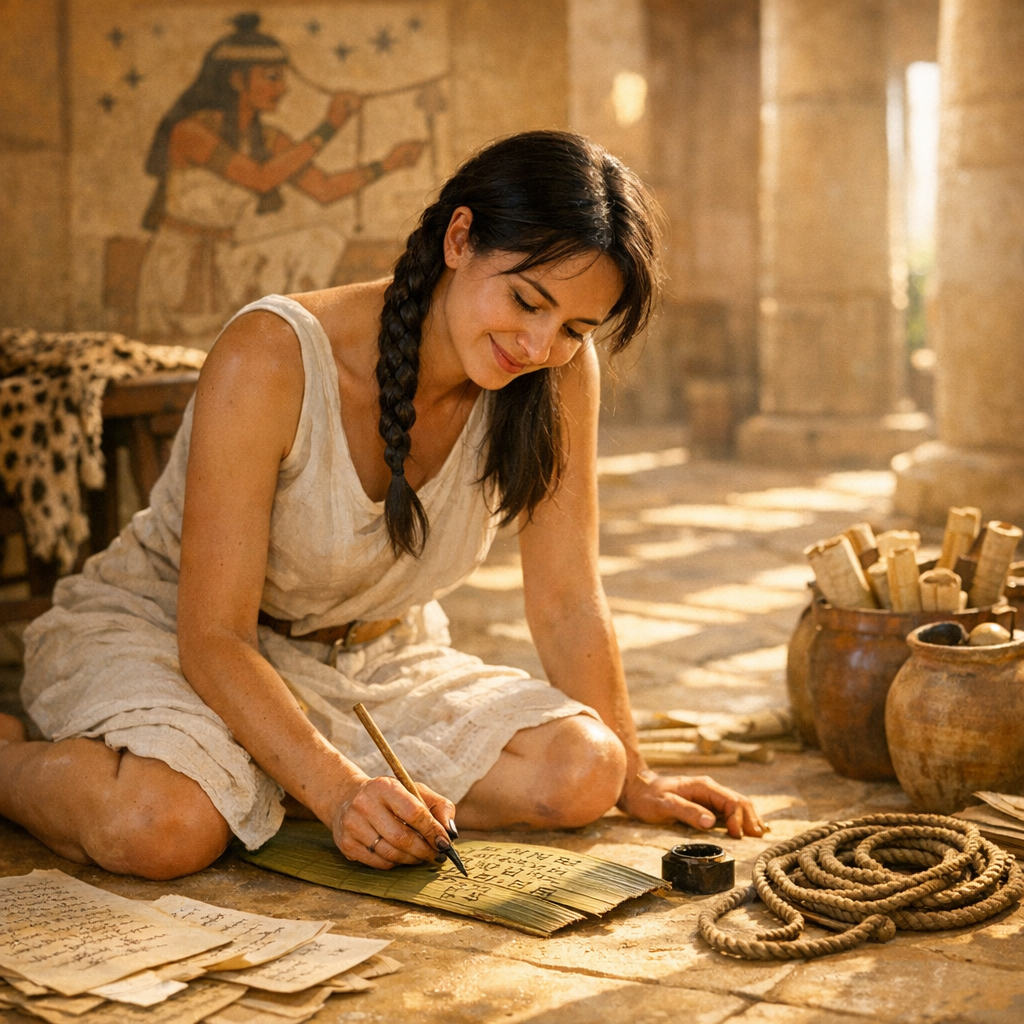
The woman who measured the temple foundations and recorded the years of the pharaohs. Not a goddess performing. A woman working with joy. The original archivist. Ink on her fingers. Stars on her walls. Every script in this vault was measured once before it was written. She was the first to hold the cord.