The Men Who Stood By
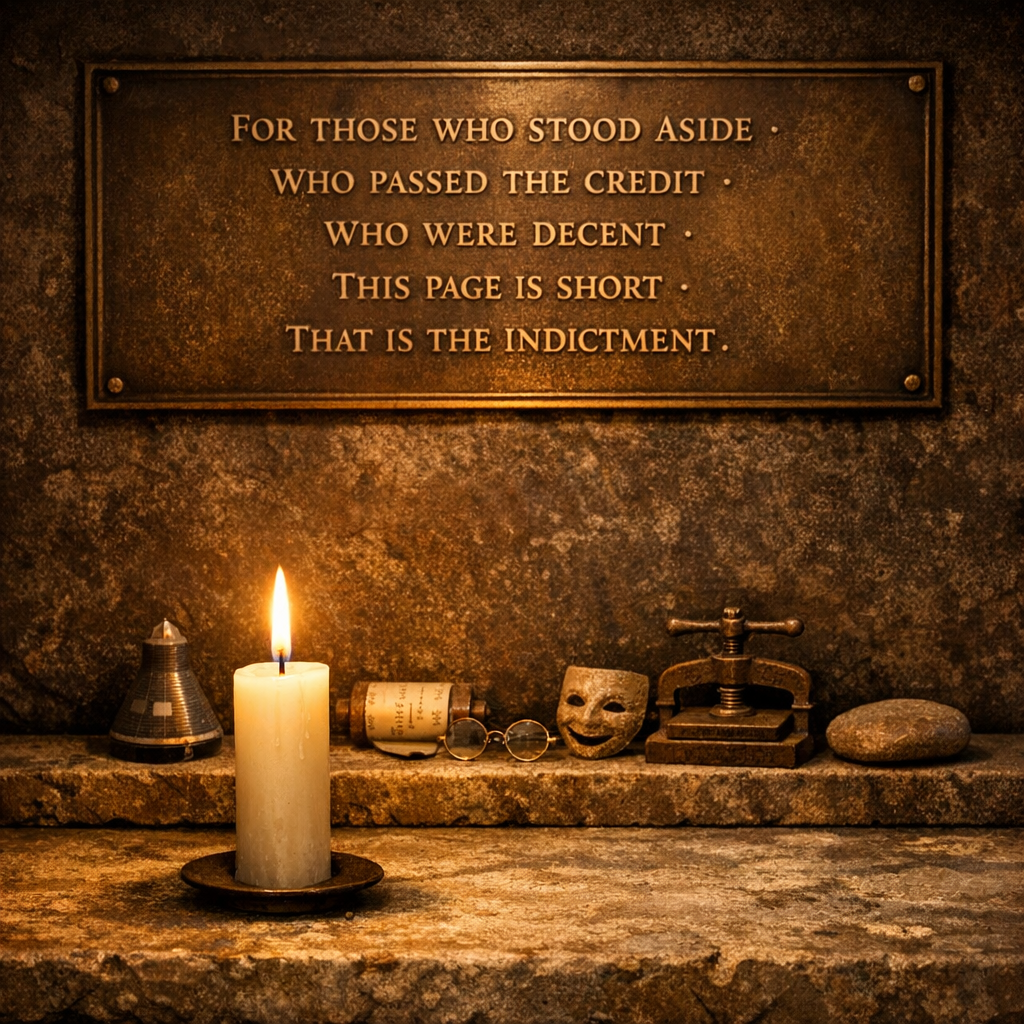
"This page is short. It could be longer. The fact that it is this short — after fifty thousand years of human civilisation — is the indictment."
John Glenn · The Astronaut Who Refused to Fly
John Glenn was about to become the first American to orbit the Earth. The trajectory had been calculated by new IBM computers. He didn't trust the machines. He wanted Katherine Johnson — a Black woman in the segregated computing division — to check the numbers. By hand. "Get the girl to check the numbers. If she says they're good, I'm ready to go." She checked them. She said they were good. He flew. He returned. He never claimed the calculation was his. He never let anyone forget whose name should be on the math. "The girl" — his words were of his era. His actions were of the one we are trying to build. He put his life in the hands of a Black woman mathematician and told the world he had done so. That was 1962. The lunchroom was still segregated. Glenn didn't care.
George Antheil · The Composer Who Shared the Patent
Hedy Lamarr had the idea for frequency-hopping spread spectrum. She needed someone to help with the synchronisation mechanism. She found George Antheil — an avant-garde composer who had once written a piece for sixteen synchronised player pianos. He understood the problem immediately. They invented it together at her dining room table, using piano rolls as the model for frequency switching. The patent was filed in both their names. "Hedy Kiesler Markey et George Antheil." He never claimed she was the assistant. He never said he discovered it and she helped. He told anyone who asked that it was her idea, her genius, and he had simply helped with the piano roll. The patent sat classified for decades. Neither of them saw a cent. Antheil died in 1959, never knowing his name was on the foundation of WiFi.
Otto Frisch · The Nephew Who Walked in the Snow
Lise Meitner was walking through the Swedish snow with her nephew Otto Frisch when she understood nuclear fission. She had just received Hahn's letter — an experimental result he couldn't explain. Uranium bombarded with neutrons was producing barium. She was the one who saw what it meant. Frisch was a physicist too. He could have published the discovery himself. He could have been the one to name "fission." Instead, he walked beside her, listened, asked the right questions, and made sure the world knew whose mind had solved the problem. He co-authored the paper with her — not in front of her name, but beside it. When Hahn later pretended Meitner had merely been his junior assistant, Frisch was one of the few who publicly corrected the record. He was her nephew. He was also her witness.
The Commedia Actors · The Men Who Froze and Waited
Columbina was funnier than every man on the commedia dell'arte stage. The audience knew it. The actors knew it. There is a moment in every Columbina scene — documented, described, passed down through company tradition — where she would deliver a line so sharp, so perfectly timed, that the male characters on stage would simply freeze. They would stop. Wait. They could not follow her rhythm. The only professional move was to stand still and let her have the moment. Every night. For decades. These men — Arlecchino, Pantalone, the lovers — were not credited as allies. They were not given a special page in history. They simply understood that the best thing they could do in that moment was nothing. That is not nothing. That is the discipline of deference. The hardest thing for a man on a stage to do is to yield the stage to a woman and mean it.
The Editor Who Published the Impossible
Cecilia Payne's PhD thesis concluded that stars are made almost entirely of hydrogen and helium. Henry Norris Russell — the most powerful astronomer in America — told her the conclusion was "impossible." He persuaded her to add a sentence walking it back. But someone at the press still published the thesis. Someone still bound it. Someone still sent it to libraries around the world, where it sat, waiting, for the astronomer who would one day realise she had been right. That person's name is not recorded. An editor. A press worker. Someone in the chain who decided that a 25-year-old woman's discovery deserved to exist in the world even though the most famous astronomer in the country had told her she was wrong. History does not know their name. They are on this page anyway.
The Men Who Listened · A Short List
Charles Babbage called Ada Lovelace the "Enchantress of Numbers" and treated her as an intellectual equal when almost no man in Victorian England would have. He did not claim her algorithm as his own. He knew whose mind had seen what the Analytical Engine could become.
The male students in Hypatia's lecture hall who travelled from across the Roman Empire to sit at the feet of a pagan woman and learn Neoplatonic philosophy from her. Some of them became bishops. One of them — Synesius of Cyrene — wrote her letters of deep affection and respect that survive to this day. He called her "mother, sister, teacher, and benefactress." He never renounced her, even when it would have been politically convenient.
The unnamed men in every era who did the decent thing and left no record. The laboratory assistant who made sure the woman's name was on the paper. The professor who recommended his female student for the position he wanted himself. The husband who cooked dinner while his wife finished her thesis. The father who told his daughter she could be anything. The son who corrected someone at a party who credited a man for a woman's discovery. These actions are not heroic. They are baseline. The fact that we are listing them at all is the problem. The Bureau exists because the baseline has not been met.